JU-works
JU SeqWorkbench Alpha
Sanger/FASTA sequence inspection, editing, grouping, visualization, and export in one local desktop workflow.
Independent personal development project
JU SeqWorkbench is developed independently as a personal software project. It is not an official product, service, software project, or development activity of my employer. The views, design choices, documentation, and development decisions presented on this site are my own.
JU SeqWorkbench Alpha is being developed for practical sequence-review work where sequence data has already been generated or prepared. The goal is to reduce repeated tool-switching between sequence inspection, editing, alignment review, grouping, mutation/variability analysis, visualization, and export.
It is not intended to replace large-scale NGS analysis platforms, read mapping, primary variant calling, or genome assembly pipelines.
September 2026 update: the first public
0.1.0-alphawill now be released after the main renderer bottleneck has been reduced enough for practical sequence review. The frozen pre-renderer baseline showed that residue coloring could take about 9.55 s on the 100 × 10,000 fixture, so the viewport-renderer work is being treated as the final pre-alpha engineering gate rather than an immediate post-release patch. The developer prototype now renders only visible rows/columns and has working Color/Dot display paths; production integration, editing parity, regression checks, and final manual validation are still in progress.
Why this project?
Routine Sanger/FASTA review can still involve moving between several tools for small but repeated tasks:
- checking aligned sequences
- editing IDs or sequence rows
- reviewing selected mutation sites
- comparing continuous regions
- grouping sequences by ID, marker rules, or similarity
- running an external MSA engine
- exporting tables, FASTA files, and figures
JU SeqWorkbench aims to connect those steps into one focused desktop workflow.
Workflow preview
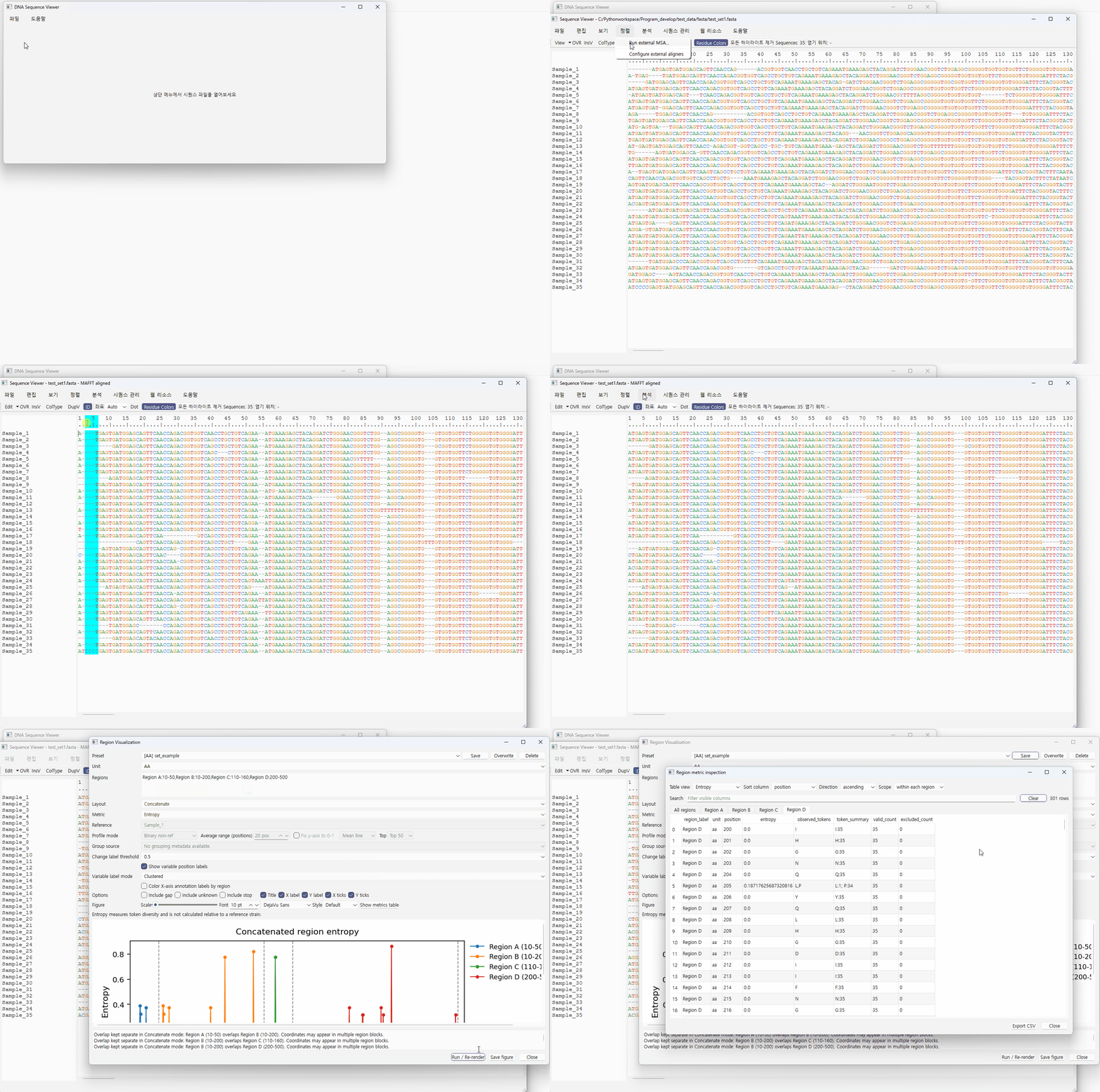
Current Alpha scope
The current 0.1.x workflow includes:
- FASTA and Sanger AB1 import/review
- chromatogram trace inspection
- editable NT/AA sequence viewing
- project save/load
- undo/redo and row/column editing workflows
- user-installed external MSA integration
- MAFFT as the recommended alpha aligner path
- optional local Clustal Omega integration
- Point Visualization for selected AA, NT, or codon sites
- Region Visualization for continuous intervals or multiple regions
- similarity clustering
- AA marker classification
- ID/name grouping
- CSV/TSV, FASTA, grouped FASTA, and figure export
- Korean / English UI support
- alpha-level preflight and busy-state guardrails for larger analysis jobs
The analysis path is designed to use the current working sequence state rather than silently falling back to stale imported data.
Known Alpha limitations
The first alpha is still not intended to look or behave like a finished commercial release. However, the current plan is not to ship the known full-document renderer bottleneck unchanged.
The main limitations that will be stated openly with the release are:
- larger alignments may still have practical limits, but the initial Alpha package will be cut only after the new renderer path clears its parity/regression and manual-validation gates
- current visualization is functional-first and will be visually modernized after alpha feedback
- relationship/tree inspection is not yet active in the alpha workflow
- ORF/segment-aware analysis is not yet implemented
- group-to-group comparison is planned for a later stage
- annotation and broader sequence-management features remain deferred
The goal of the first public alpha is workflow validation: does the current sequence-review process save time, and which analysis/visualization views are actually worth improving next?
Performance baseline
A JU-only pre-renderer performance baseline has now been frozen before the planned renderer migration. It is intended as a development reference for later before/after optimization work, not as a ranking against other software.
The public baseline contains 5 synthetic alignment fixtures × 8 renderer metrics and reports median/min/max timings under the documented Windows/Qt test conditions.
Alpha → Beta → Full Release direction
The project roadmap is intentionally conservative. Post-alpha development is focused on improving the existing workflow before adding unrelated platform-scale features.
Interaction-network roadmap
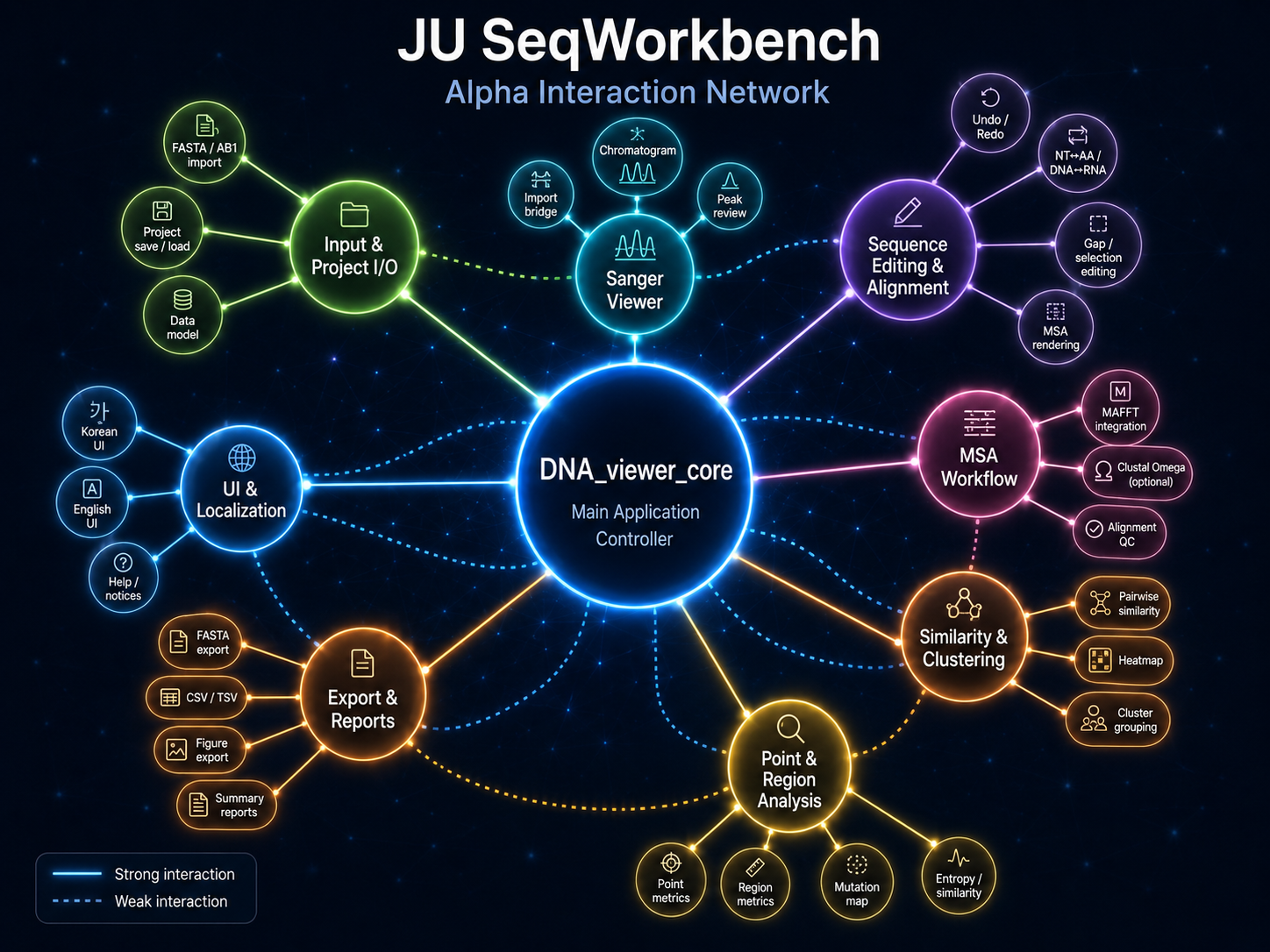
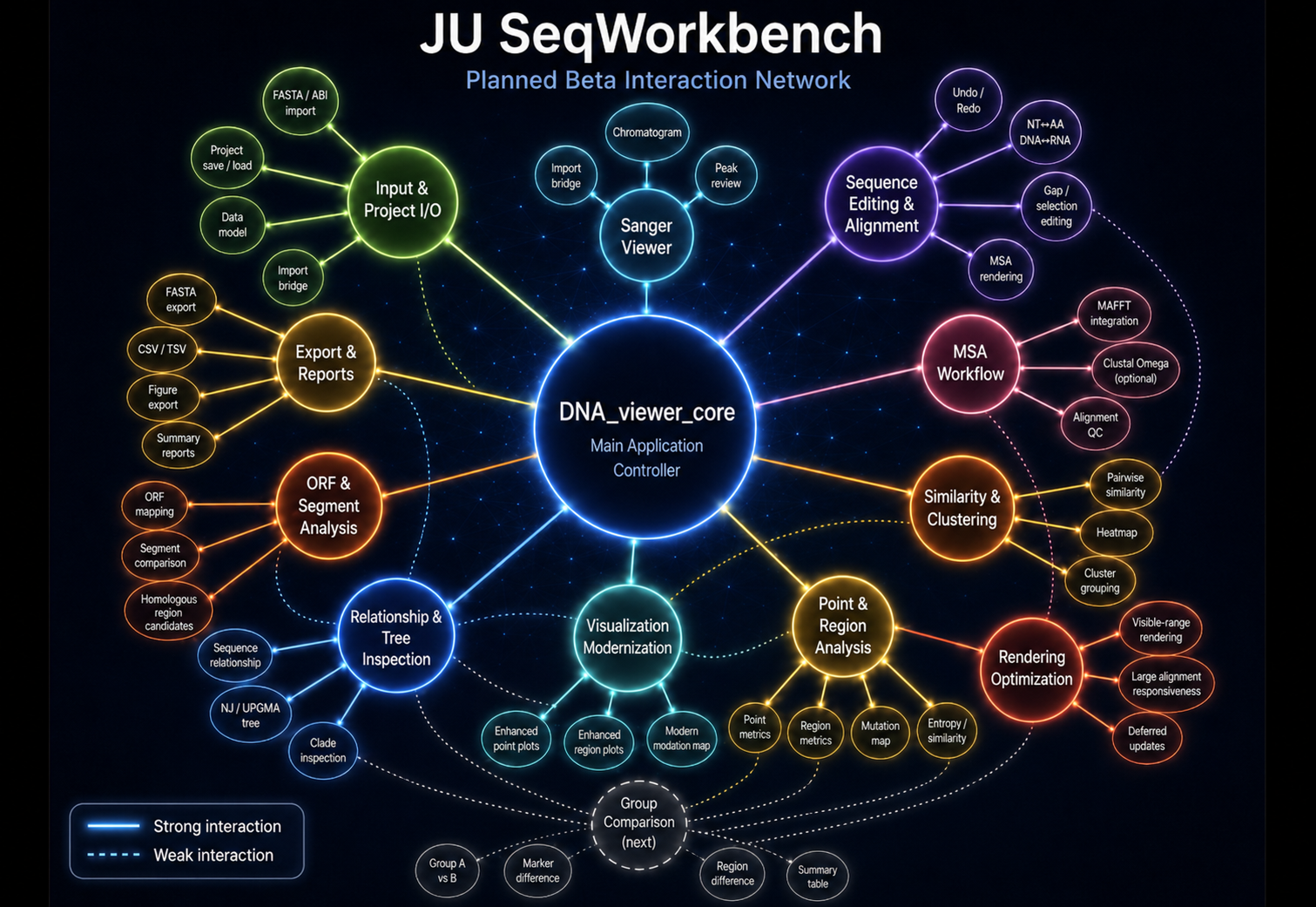
The diagrams below are a visual interpretation of how the current modules interact and how the workflow may expand over time. Solid lines represent primary/strong workflow interactions; dotted lines represent weaker, supporting, or cross-module interactions.
Alpha — current interaction network
Planned Beta interaction network
Possible Full Release interaction network
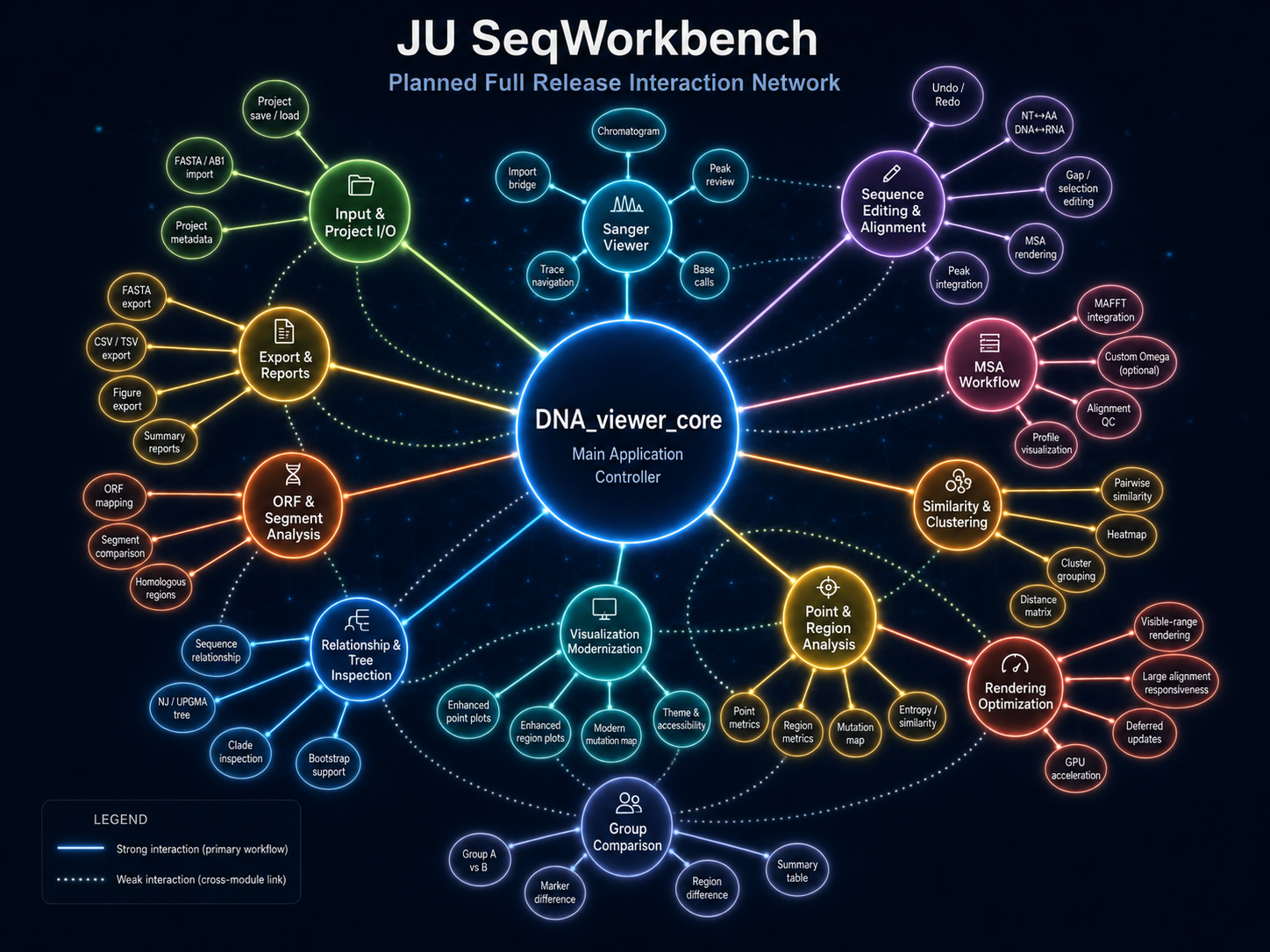
Beta and Full Release diagrams are conceptual roadmaps. Their exact structure may change based on implementation results, alpha feedback, and workflow priorities.
Alpha — current foundation
FASTA / AB1 input
→ sequence review and editing
→ external MSA / alignment review
→ grouping / typing / similarity
→ point or region analysis
→ visualization / export
Beta — first post-alpha priorities
The current expected priorities are:
- Renderer follow-up and stabilization
- continue tuning after the initial pre-alpha bottleneck fix
- preserve the old renderer as a fallback/reference during early migration
- tighten resize, selection/editing, and large-alignment edge cases based on Alpha feedback
- Visualization modernization
- improve Point plots
- improve Region plots
- modernize mutation maps and summary layouts
- make it easier to move from a visual pattern back to the underlying sequences
- Sequence relationship and tree inspection
- NT/AA sequence relationship views
- pairwise similarity/distance inspection
- simple NJ/UPGMA-style distance-tree views
- clade/subset selection linked back to the alignment workflow
- ORF- and segment-aware analysis
- ORF mapping/selection
- segment-level comparison
- candidate homologous-region exploration
- selection of comparable clades/ORFs/segments before detailed site analysis
Group-to-group comparison remains important, but is currently positioned after these first post-alpha priorities.
Toward a full release
The likely full-release direction is to integrate and stabilize the workflows that prove useful during alpha/beta testing:
- optimized rendering and responsiveness
- modernized Point/Region visualization
- relationship/tree-assisted inspection
- ORF- and segment-aware analysis
- group-to-group comparison
- stronger comparison summaries and export/report workflows
- selected annotation/metadata features where they directly support sequence comparison
Cloud collaboration, enterprise administration, large API ecosystems, and fully integrated AI analysis are not currently committed full-release requirements.
Sanger AB1 workflow
The AB1 workflow supports opening Sanger trace files, displaying chromatogram traces, reviewing the basecalled sequence, choosing original or reverse-complement orientation, trimming an import range, and bringing the selected sequence into the main viewer workflow.
External MSA
JU SeqWorkbench does not reimplement a multiple-sequence aligner. The alpha workflow connects to separately installed external aligners through temporary FASTA files and returns the aligned result to the viewer.
- MAFFT — recommended alpha path
- Clustal Omega — optional when the user already has a local executable
External aligner binaries are not bundled or automatically downloaded by the current alpha build.
Visualization and inspection
The visualization workflow deliberately separates two different questions:
- Point Visualization — selected AA, NT, or codon positions
- Region Visualization — continuous intervals or multiple regions
The current plots are intended to validate the analysis workflow first. Visual hierarchy, comparison layouts, mutation maps, and publication/report-oriented presentation will be improved after real user feedback.
Feedback wanted
Feedback from people who review Sanger results, FASTA files, small MSA datasets, viral sequences, or amplicon sequence sets is especially useful.
Useful feedback includes:
- which sequence-review steps feel repetitive or inconvenient
- whether FASTA → MSA → inspection → export matches a real workflow
- which Point or Region visualization formats you would actually use
- how you would want to compare groups, ORFs, segments, or related sequence sets
- whether relationship/tree inspection should appear before detailed site/region analysis
- examples of figures or tables from papers or other tools that communicate the result better
If possible, describe what data should be compared and what you want to see from it.
Please do not upload confidential or unpublished sequence data publicly.
Development logs
Foundation
- Devlog 01 — Project Direction
- Devlog 02 — Data Layer and Working State
- Devlog 03 — Editing and Interaction Model
Analysis and visualization
- Devlog 04 — Classification and Grouping
- Devlog 05 — Visualization and Inspection
- Devlog 06 — Sequence Relationship and Tree-Based Inspection
- Devlog 07 — Annotation and Region Metadata
Output, Sanger, and alpha preparation
- Devlog 08 — Export and Reporting Workflow
- Devlog 09 — Sanger AB1 Workflow
- Devlog 10 — External MSA Workflow
- Devlog 11 — Packaging, License, and Alpha Preparation
Planned / upcoming development topics
The following areas are planned or under active exploration. Dedicated devlog pages will be linked when implementation and validation are mature enough to document clearly.
- Renderer and viewport optimization — current pre-alpha work to improve responsiveness while preserving editing, coloring, Dot mode, highlighting, and selection behavior
- Visualization modernization — clearer Point/Region views, mutation maps, comparison summaries, and more useful links back to the underlying sequences
- ORF- and segment-aware analysis — treating ORFs and genome segments as distinct biological levels for comparison and selection before site-level analysis
- Group-to-group comparison — comparing selected sequence groups and their variability/pattern summaries
- ID normalization and reusable subset filtering — batch-cleaning inconsistent FASTA IDs and reusing standardized IDs to extract different sequence subsets efficiently
- Structure-linked sequence inspection — future exploration of loading PDB/mmCIF structures and mapping selected variants or group differences onto a structure viewer
These are roadmap topics rather than promises for a specific release, and their order may change based on alpha feedback and implementation results.
Documentation
User guides
- Korean User Guide — online
- English User Guide — online
- Download Korean User Guide (PDF)
- Download English User Guide (PDF)
Project documentation
Feedback links
- Bug reports / reproducible errors / feature requests: GitHub Issues
- Questions / ideas / visualization requests / general feedback: GitHub Discussions
Please do not upload confidential or unpublished sequence data publicly.